Types of Training Funded

The United States and its international partners provide a variety of training to the Ukrainian Armed Forces (UAF), including basic, collective, leadership, and platform-specific training. In coordination with the Department of State, U.S. Congress has appropriated $33.5 billion for the Ukraine Security Assistance Initiative (USAI), which supports a variety of security assistance activities including, but not limited to: Intelligence support, personnel training, equipment and logistics support, supplies and other services.

U.S., NATO, and International Training Support to Ukrainian Armed Forces

The United States and its international partners provide a variety of training to the UAF, including basic, collective, leadership, and platform-specific training. NATO SecurityAssistance and Training for Ukraine (NSATU) is responsible for coordinating allied logistics, training, and planning efforts. The Security Assistance Group Ukraine (SAG-U) is responsible for coordinating U.S. assistance. As of FY24 most UAF basic training 90 percent is conducted by Ukrainians in Ukraine.

U.S. military trainers located at Grafenwoehr Training Area in Germany, as well as other locations in Europe and the United States, provided primarily collective, leadership, and equipment training to the UAF. The United States and NATO allies trained UAF personnel in Germany, Poland, Spain, Kosovo and other sites across Europe.
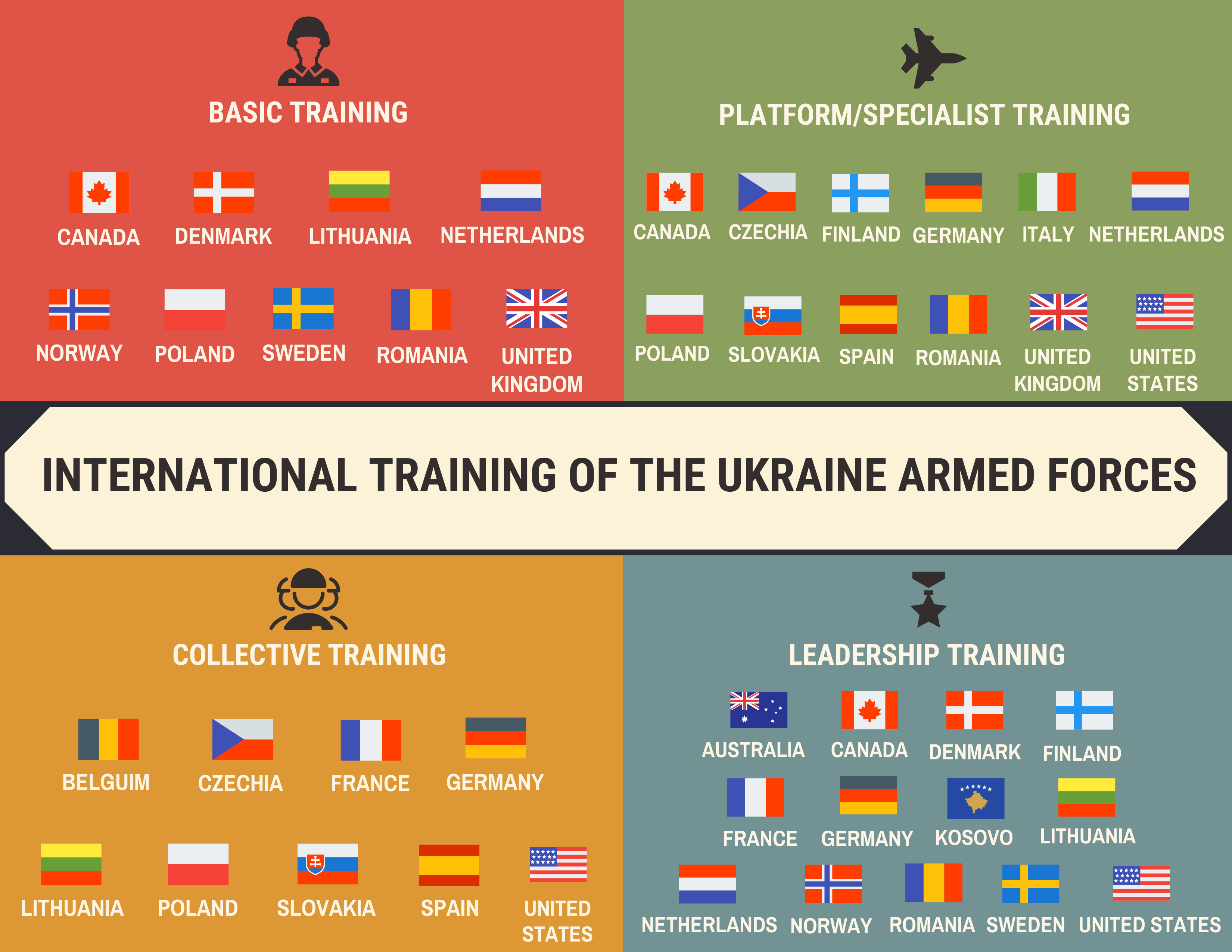
International Training of the Ukranian Armed Forces (UAF)
Note: All information on partner nation contributions is reported voluntarily, and many donor nations do not share information on the totality of their contributions, which makes it difficult to calculate total numbers for international training support.

Sources: Security Assistance Group-Ukraine

U.S. Support Highlights

U.S. Air Force F-16 Fighting Falcons
Source: DVIDSHUB.net U.S. Air Force F-16 Fighting Falcons with the 122nd Fighter Wing, Indiana Air National Guard, sit on the flightline after heavy snowfall during Sentry Savannah 25 at the Air Dominance Center in Savannah, Ga., Jan 22, 2025. (U.S. Air National Guard photo by Staff Sgt. Josiah Meece)

F-16 Training

The United States continued to train Ukrainian F-16 pilots and maintainers with anticipated graduation in 2026. This training program is aligned with partner training commitments as coordinated through the Air Force Capability Coalition co-led by Denmark, the Netherlands, and the United States. 

Air and Missile Defense

U.S. personnel continue to provide air and missile defense training in Germany. SAG-U reported continued improvement of Ukrainian air defense capability to levels beyond any other point in the war. SAG-U attributed high intercept rates during Russia’s air attacks in November 2024 to the equipment and training the Ukrainians have received.

Maintenance

The UAF is generally able to maintain U.S. systems at sites inside Ukraine as long as they have adequate spare parts, technical documents, and specialized tools with test and diagnostic equipment, according to SAG-U. NATO partners have also combined efforts to provide maintenance assistance to Ukraine for air defense assets. In early 2025, NATO assumed control of the logistics and maintenance node in Poland and consequently, U.S. maintenance activity shifted to facilities in Germany.

Unmanned Aerial Systems (UAS)

JMTG-U said that UAF trainees consistently requested training on electronic warfare but that it was unable to provide training on any meaningful scale due to lack of electronic warfare personnel, equipment, and training space. Additionally, JMTG-U experienced challenges with UAS training related to maintenance issues with certain systems in the UAS inventory and lack of training space sufficient to conduct training on the scale required to simulate battlefield conditions in Ukraine.

What's New in the Latest Report?

USEUCOM  reported that it continued to work closely with NATO allies and partners bilaterally and multilaterally to develop and implement initiatives aimed at training and preparing allies to assume a greater share of responsibility for European defense. Although some eastern flank host countries expressed initial concerns about potential impacts to regional security with the U.S. coordinating its reduction of U.S. troops, USEUCOM stated that ongoing collaboration with these countries, including an increase in episodic training events in the region, helped address these concerns and maintain strong bilateral relationships

USEUCOM conducted and participated in several joint and multinational exercises in the second half of 2025. USEUCOM said that these exercises improved the readiness and interoperability of U.S. forces with NATO allies and partners. These exercises have also demonstrated the collective defense capabilities of the alliance. 


Training & Advising Details

  • Congress has appropriated about $7.1 billion to the Department of State for FMF to include military training.
  • Nearly $1.4 billion of FMF appropriations are yet to be obligated.
  • Roughly $2.4 billion of FMF appropriations are allocated to Ukraine.
  • Roughly $3.2 billion of FMF appropriations are allocated to the rest of Europe.
  • About $2.3 billion of total FMF funding has been disbursed.
Read more about Training and Advising in the latest report

Train and Assist Glossary

Quick Links
 

Google Translation Disclaimer

  • Google Translate, a third party service provided by Google, performs all translations directly and dynamically.
  • Ukraine Oversight, www.ukraineoversight.gov has no control over the features, functions, or performance of the Google Translate service.
  • The automated translations should not be considered exact and should be used only as an approximation of the original English language content.
  • This service is meant solely for the assistance of limited English-speaking users of the website.
  • Ukraine Oversight, www.ukraineoversight.gov does not warrant the accuracy, reliability, or timeliness of any information translated.
  • Some items cannot be translated, including but not limited to image buttons, drop down menus, graphics, photos, or portable document formats (pdfs).
  • Ukraine Oversight, www.ukraineoversight.gov does not directly endorse Google Translate or imply that it is the only language translation solution available to users.
  • All site visitors may choose to use similar tools for their translation needs. Any individuals or parties that use Ukraine Oversight, www.ukraineoversight.gov content in translated form, whether by Google Translate or by any other translation services, do so at their own risk.
  • IE users: Please note that Google Translate may not render correctly when using Internet Explorer. Users are advised to use MS Edge, Safari, Chrome, or Firefox browser to take full advantage of the Google Translate feature.
  • The official text of content on this site is the English version found on this website. If any questions arise related to the accuracy of the information contained in translated text, refer to the English version on this website, it is the official version.